Fifteen Minutes at the Hatch: Auditing Depot Collection as a Delivery Channel
Collection counters are frequently described as an exception: the parcel that could not be delivered, the customer who preferred to collect, the trade account that sends a van to the depot. In practice, the counter is a delivery method. It has a service promise, a cost to serve, a failure rate and a customer experience. For UK SMEs and depot teams, the difficulty is that this channel is rarely measured with the same discipline as the van route.
A useful starting point is a single service standard: fifteen minutes from arrival to departure for a planned collection. That standard is not a target for every visit. It is a diagnostic. Where the depot cannot meet it, the audit should reveal whether the constraint sits in parking, queue design, identity checks, parcel location, proof capture or staff cover. The purpose is not to hurry customers. It is to remove avoidable waiting from a handover that should be predictable.
Define the collection promise before measuring it
Many depots advertise opening hours but not a collection window. A customer may be told that the counter is open from 8am to 6pm, yet arrive at 12.30pm to find a queue of trade accounts and a single member of staff searching for an oversized item. The first audit task is to separate advertised opening hours from a realistic collection promise.
A workable promise for most UK depots is a named window, a stated cut-off for same-day collection and a clear note on what the customer must bring. The promise should be visible on the collection notice, in the SMS or email reminder and at the counter itself. If the depot cannot guarantee a fifteen-minute handover at every hour, it should say when the standard applies and what happens outside it.
Map demand by hour, day and parcel type
Before changing staffing or layout, collect three weeks of counter data. Record arrival time, time called to the counter, handover time, departure time, parcel type, whether identification was checked, whether proof was captured and the reason for any delay. This need not be a complex system. A paper tally at the counter is sufficient if it is completed consistently.
The pattern usually matters more than the average. A depot may handle most collections between 4pm and 6pm, when the afternoon van returns and the counter competes with trade enquiries. Another may see a lunchtime surge from nearby industrial estates. Parcel type also affects flow: small packets can be handed over quickly, while long or heavy items may require a second operative, a trolley or an outdoor handover point.
Parking is part of the service
A collection fails before the customer reaches the hatch if there is nowhere to stop. The audit should observe arrival parking at peak times, not just at quiet moments. Note whether customers circle the yard, block loading bays, park on access roads or abandon vehicles in a way that creates a safety risk.
Where space allows, two clearly marked short-stay collection bays can do more for punctuality than an extra counter clerk. Signage should direct collection customers from the entrance, not through a general trade counter queue. During peak weeks, a temporary collection bay may need to be separated from van loading activity. The aim is to keep collection traffic from interrupting despatch flow and to keep customers out of vehicle movement areas.
Design queue flow around the handover
Counter layout should support four steps: arrive, wait, present, leave. If customers queue across the entrance, stand in a picking aisle or wait beside outward goods, the process creates avoidable friction. A simple three-line sign at the door can set expectations: have your collection reference ready, have identification ready and wait for your number.
Separate collection from returns and trade enquiries where volumes justify it. A dedicated collection point reduces the time staff spend switching between tasks and protects customer privacy. Where a separate point is not possible, use a floor marking and a queue trigger. If more than four customers are waiting, a second member of staff should be called before the queue reaches the counter.
Make identity checks consistent without slowing the line
Identity checks are a control, not a courtesy. The audit should confirm what is checked for each collection type: photo identification, collection reference, proof of address or an authorised collector list for business accounts. Inconsistency creates both fraud risk and customer frustration, particularly when one shift asks for a document that another does not.
A short script helps. Staff should ask for the reference and identification before searching for the parcel, and should avoid announcing contents or value at the counter. For business accounts, maintain a current list of authorised collectors and a clear process for adding or removing names. The check should be recorded in the collection log without unnecessary personal data being copied.
Capture proof of collection at the point of handover
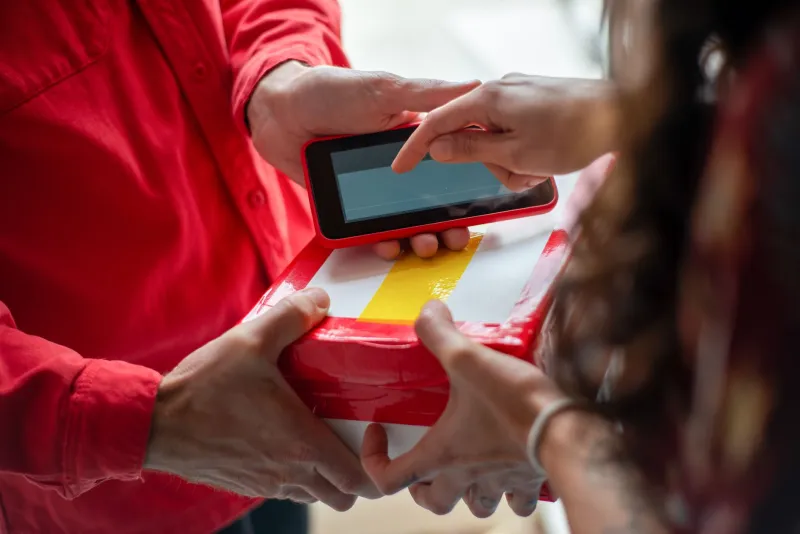
Proof of collection is the counter equivalent of a delivery signature. The audit should test whether the depot captures collector name, parcel reference, date, time and staff initials for every handover. A digital pad or scanned collection note is preferable where available, but a controlled paper log is better than no record.
The proof should be quick enough to sit inside the fifteen-minute standard. If the capture process adds two minutes per customer, it needs redesign. The test is simple: can a member of staff complete the record while the parcel is being handed over, without turning the counter into a paperwork exercise?
Staff cover and peak-week pressure
Collection counters are often staffed by whoever is available. That works until peak season or a staff absence exposes the gap. The audit should name a collection champion for each shift and a backup. It should also set an escalation rule: if the queue exceeds a stated length or the wait exceeds ten minutes, additional cover is called.
Peak weeks in November and December 2026 will compress collection demand into fewer hours. A roster that treats the counter as a secondary duty is likely to fail. The depot should publish a peak collection window, adjust staff breaks away from the busiest hour and brief drivers and warehouse teams on where collection parcels are held.
Fallback rules for missed slots and exceptions
A predictable channel needs predictable exceptions. If a customer misses the collection window, the depot should apply a published rule: hold for a stated number of days, offer a rebooking slot or return the parcel to the carrier. If identification cannot be verified, no release should occur without a supervised call to the account holder. If the parcel cannot be found within ten minutes, the customer should be given a callback time and the item logged as a counter exception.
These rules protect staff from making ad hoc decisions under pressure. They also give customers a clear route when the fifteen-minute standard cannot be met.
A one-page collection-window audit template
A practical audit sheet can be completed by a supervisor in one shift and reviewed weekly. Record the date and shift, the advertised collection window, arrivals by hour, average arrival-to-departure time, maximum queue length, parking observations, identity exceptions, proof capture rate, staff on the counter, missed slots and the fallback applied. Add an action column with an owner and review date.
The template should be short enough to use during a live shift. Its value lies in repetition. One completed sheet is an anecdote; four consecutive weeks show whether the counter is a controlled channel or an unmeasured bottleneck.
Review the standard, not just the queue
Collection is a delivery method with its own service promise. When a UK depot measures the counter with the same care as the van route, the fifteen-minute handover becomes less a slogan and more an operating standard. The audit does not require new technology. It requires a window, a stopwatch, a log and a willingness to treat the customer at the hatch as part of the distribution plan.