The Unrecorded Minute: A Despatch Observation Day That Improves First-Time Delivery
Most despatch reviews begin and end with the data the handheld already captures: the scan time, the route order, the exception code. That record is useful, but it is also selective. It shows that a stop took four minutes; it does not show why. It records a failed delivery; it does not explain that the driver had nowhere legal to stop, that the buzzer was mislabelled, or that the reception closed at three o'clock without telling anyone. For UK SMEs running their own vehicles or managing a close carrier relationship, a structured observation day can close that gap.
The aim is not to audit the driver. It is to audit the route as it is actually worked. The distinction matters. A manager who arrives with a clipboard and a performance agenda will see a rehearsed version of the job. A manager who arrives as an observer, willing to carry a bag and keep quiet at the doorstep, will see the operational friction that never reaches the depot.
Why the Scan Sheet Is Only Half the Story
Delivery data is excellent at recording outcomes and poor at recording causes. A first-time delivery failure may be logged as customer not available, when the more accurate description is that the address sits on a red route with no loading bay and the driver had already circled the block twice. A route may look efficient on screen because the sequence is tight, yet in practice it forces the driver to cross a busy high street three times before midday.
These are not minor details. They affect fuel, time, driver stress and, ultimately, the customer experience. In a year when urban traffic restrictions and parking enforcement continue to tighten, the gap between the planned route and the worked route deserves more attention than it often receives.
Before Joining the Route
An observation day should be arranged openly. Tell the driver why you are coming and what you hope to learn. Confirm that the day is not a disciplinary exercise and that the notes will be used to remove obstacles, not to create new ones. Choose a typical day rather than the quietest or the busiest, and avoid the first day after a bank holiday if you want a representative picture.
Bring minimal equipment: a notebook, a charged phone and a willingness to stay out of the way. Do not take over the route. Do not offer a running commentary from the passenger seat. The value of the day lies in watching how the round is actually worked, not in demonstrating how it might be worked from a spreadsheet.
What to Watch Beyond the Scan
Parking and access pressure
Note every stop where the vehicle cannot be parked legally or safely within a reasonable distance. Observe how long the driver spends looking for a space, how far they carry the parcel and whether the stop depends on a particular loading bay being free. These are the hidden minutes that never appear in a route plan. They also shape driver behaviour: repeated pressure to park illegally or carry parcels down long streets increases risk and reduces willingness to stay in the role.
Gate codes, buzzers and building quirks
Watch what the driver has to remember. Gate codes, side entrances, reception hours, concierge procedures and the difference between the front door and the goods entrance are all essential knowledge that often lives only in the driver's head. If that knowledge is lost when a driver leaves, the next person repeats the same mistakes. A small access-notes field in the route manifest can preserve it without creating a heavy administrative burden.
Handover friction
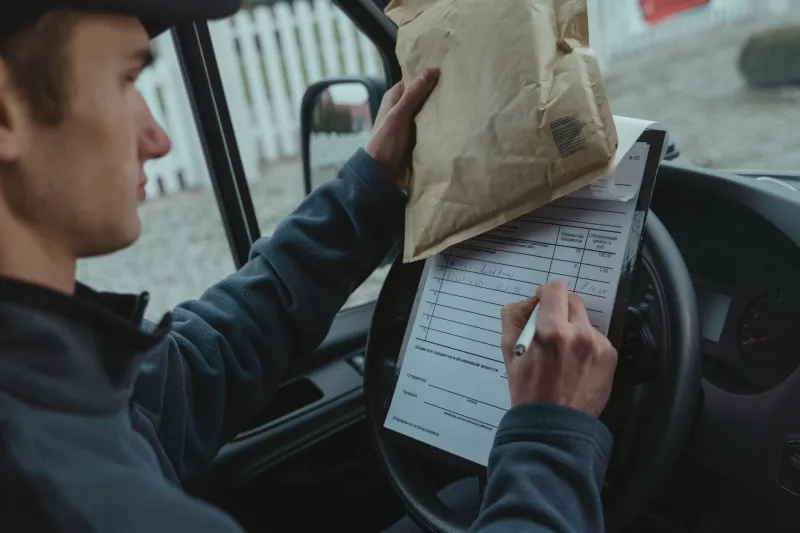
The doorstep is where the delivery is either completed or abandoned. Observe how long a handover takes, whether the customer is expecting the parcel, whether identification is requested and whether the driver has a clear place to leave a safe-place delivery. Friction here is often caused by information failures upstream: an address record that lacks a flat number, a phone number that rings out, or a delivery instruction that contradicts the building's actual layout.
Route sequencing in practice
Compare the planned sequence with the worked sequence. Drivers often make small adjustments that the planning system does not see: serving a school before the gates close, reaching a market town before the parking wardens start, or taking a rural stop while the light is still good. Ask why those adjustments are made. Some can be built into the plan; others reveal constraints that need to be recorded.
The driver's own account
On the return leg, ask open questions. Which stop is consistently the most difficult? Where does the route plan feel wrong? What would make the day easier without compromising service? The answers are not always actionable in themselves, but they point to the parts of the operation that need a closer look.
The Debrief That Changes Behaviour
A ride-along is only useful if it produces a short, specific follow-up. Within forty-eight hours, sit down with the driver and agree which observations will be taken forward. Avoid a long list. Three to five actions are enough to show that the day was worthwhile and to keep the momentum. Record the outcome so that the next observation day does not cover the same ground.
A Post-Ride Action List for the Following Week
- Update access notes. Add gate codes, reception hours, loading bay restrictions and safe-place guidance to the address record for the stops that caused the most friction.
- Fix the address data. Correct missing flat numbers, unclear business names and contradictory delivery instructions before the next peak cycle.
- Review the tightest time windows. Where a route depends on a school, market or reception closing time, build the constraint into the plan rather than leaving it to driver memory.
- Check parking and access assumptions. Identify stops where the planned vehicle cannot legally or safely wait and consider alternatives such as nearby collection points or adjusted call-ahead arrangements.
- Standardise the handover where possible. A short, consistent procedure for identification, safe place and proof of delivery reduces doorstep debate and protects both driver and customer.
- Follow up with the driver. Confirm what has changed and what has not. The credibility of the whole exercise depends on this step.
Driver retention is not only a pay question. It is also a question of whether the job is made harder than it needs to be by information that exists somewhere in the business but never reaches the cab. A day in the passenger seat is a modest investment of time. Used properly, it turns unrecorded minutes into practical changes that improve first-time delivery rates and show drivers that their operational knowledge is taken seriously.