Lockers on the Pavement: A Practical High-Street Delivery Framework for UK SMEs
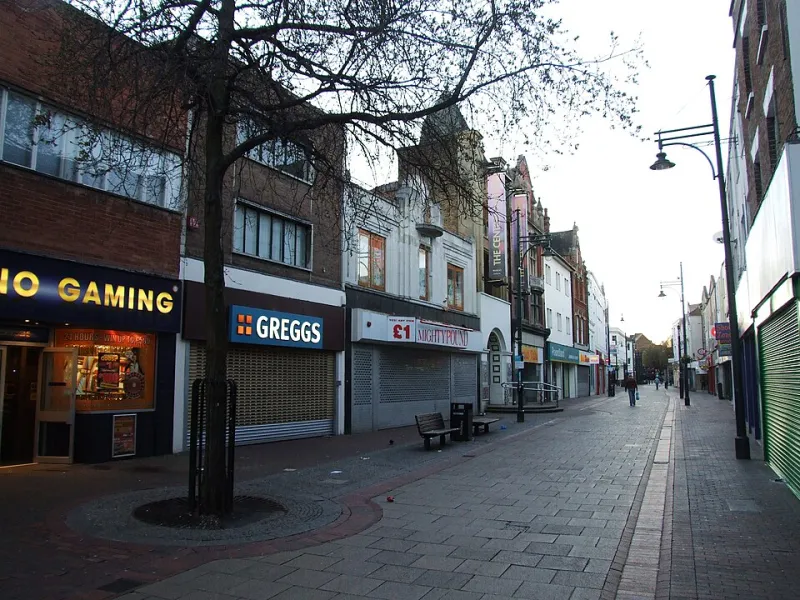
Photo: Chris Whippet , CC BY-SA 2.0, via Wikimedia Commons
Out-of-home delivery has become a familiar sight in the UK, but mostly at the edge of town: petrol forecourts, supermarket car parks and retail parks with space to spare. The next question is whether parcel lockers and click-and-collect points can work as high-street fixtures, supporting local retail rather than simply extracting parcels from it. For SMEs, the appeal is practical: fewer failed deliveries, more predictable handovers and a delivery option that does not depend on someone being at home.
The case is not about technology. It is about infrastructure. A locker is a piece of street furniture with a power supply, a data connection, a landlord and a maintenance contract. If those pieces are not in place, the technology is irrelevant.
Why the high street is being reconsidered
UK town centres have a supply of vacant units, underused forecourts and pavement space that local authorities are keen to see activated. At the same time, carriers are looking for delivery density. A locker in a residential suburb can serve a catchment of online shoppers; a locker on a high street can serve shoppers, workers and local businesses in one location. The commercial logic is strongest where the locker is attached to a host that already has footfall and a reason for people to visit.
That host might be a convenience store, a pharmacy, a library, a community centre or a retail unit with excess frontage. The locker does not need to be the main attraction. It needs to be convenient, accessible and reliable. For SMEs, the opportunity is often as a host or a partner rather than as a carrier.
The operational case in plain numbers
A high-street locker should be assessed on utilisation, not novelty. The relevant questions are simple. How many parcels per locker per day can the site realistically handle? What is the catchment within a five-minute walk? How many carrier networks will deliver to the locker? What proportion of parcels are too large for the locker and will need an overflow arrangement? What happens when the locker is full?
For an SME, the pilot should start with a modest capacity and a clear overflow route. A locker that is full by Tuesday and inaccessible by Thursday is worse than no locker at all. The site should also be assessed for accessibility, lighting, shelter and pavement width. A locker that obstructs a footway or cannot be reached by a wheelchair user will attract complaints and, potentially, enforcement action.
Carrier partnerships: start with one, not five
A common mistake is to assume that more carrier networks automatically mean more value. In practice, each carrier integration brings its own service levels, settlement terms, label rules and customer-service obligations. For a small site, one or two carrier partners may be enough to prove demand.
The commercial agreement should clarify who owns the customer relationship. If a parcel is delivered to a locker but the customer cannot open it, who handles the query? If a parcel is too large, who contacts the customer? If the locker is out of service, where does the parcel go? These are operational questions, not legal footnotes. They determine whether the locker reduces failed deliveries or simply moves the failure to a different location.
SMEs may also access locker networks through an aggregator or a carrier-agnostic platform. That can reduce integration effort, but it can also add a layer of cost and reduce control over the service promise. The right model depends on volume and on how much of the customer experience the business wants to own.
Council and planning hurdles
High-street lockers sit at the intersection of several permissions. The first is land ownership: the local authority, a private landlord or a Business Improvement District may control the pavement or forecourt. The second is highway consent or a pavement licence, depending on the site and the local authority's approach. The third is planning permission or prior approval, which may be required for a structure of a certain size or in a conservation area. The fourth is accessibility and highway safety, including sightlines and pedestrian flow.
These hurdles are not unique to lockers, but they are easy to underestimate. A pilot framework should include early engagement with the local planning authority and highways team, not a retrospective application after the unit has been ordered. In conservation areas or near listed buildings, the design and siting of the locker will matter as much as its function. In some town centres, a condition may require the locker to be removed if it causes obstruction or anti-social behaviour.
Business Improvement Districts can be useful partners. They often understand which sites are available, which landlords are receptive and which local retailers might host a locker. They can also help coordinate a pilot across several sites rather than leaving each business to negotiate separately.
A pilot framework for SMEs
A practical pilot can be run in stages over roughly six months. The first stage is demand mapping, lasting four weeks. This should use existing delivery data, customer postcodes and local footfall information to identify a catchment. The second stage is site shortlisting, lasting two weeks. This should assess ownership, access, power, data, pavement width and host willingness. The third stage is partner selection, lasting three weeks. This should compare carrier coverage, settlement terms and overflow arrangements.
The fourth stage is permissions and landlord agreement, which can take eight to twelve weeks depending on the site. The fifth stage is installation, typically two to four weeks. The sixth stage is a twelve-week live pilot. The seventh stage is a review against agreed metrics.
Those metrics should include parcels per locker per day, locker utilisation by day of week, failed handover rate, customer collection time, overflow volume, customer satisfaction and local redemption. Local redemption is particularly important for high-street sites: if customers collect a parcel and then spend in nearby shops, the locker has a wider commercial case. If they collect and leave immediately, the host may still benefit from footfall, but the town centre case is weaker.
Commercial models and risks
There are several commercial models. The host may receive a rent or revenue share. The carrier may fund the locker in exchange for network access. A local authority may subsidise the site as part of a high-street regeneration programme. An SME may use the locker to support its own click-and-collect operation rather than as a public carrier facility.
Each model carries risks. Capacity risk is the most obvious: lockers fill up faster than expected during peak periods. Maintenance risk is the second: a broken locker is a visible failure on the high street. Accessibility risk is the third: a poorly sited locker can exclude disabled customers. Customer-confusion risk is the fourth: if the locker is not clearly branded and explained, customers may not use it.
The mitigation is not a more complex technology platform. It is a clear operating agreement, a visible customer-service route and a realistic overflow plan. For UK SMEs, the high-street locker is most likely to succeed as a modest, well-sited piece of local delivery infrastructure, not as a standalone attraction. The test is whether it makes delivery more reliable for customers and more viable for the businesses that host it.